


The Connected Care Summit: Bridging Distance, held on April 23, 2026, at the Penrose House in Colorado Springs, brought together healthcare leaders and innovators to discuss the evolution of telehealth in Colorado. Moderated by Elizabeth Krupinski, PhD, and supported by the Southwest Telehealth Resource Center (SWTRC) and the Colorado Office of eHealth Innovation (OeHI), the event underscored a pivotal shift: viewing telehealth not as a separate category, but simply as "healthcare" delivered through innovative means.
The summit opened with remarks from Lieutenant Governor Dianne Primavera. Lt. Governor Primavera is the Director of the Office of Saving People Money on Health Care and leads OeHI. She emphasized that a person’s location should never determine their quality of life. She detailed Colorado Health Information Technology (IT) Roadmap, which is built on three essential pillars: enhancing community engagement in health IT solutions, supporting secure and appropriate sharing of data, and fostering responsible innovation. The roadmap was informed through significant community engagement across the state. The event focused on the unique challenges faced by rural communities, such as specialized physician shortages and the "digital divide".
Ashley Heathfield, Senior Telehealth Project Manager for OeHI, led off the talks discussing telehealth and health IT innovation. OeHI is Colorado’s State-Designated Entity for all health IT strategy, policy, and funding coordination. It is a division within the Governor’s Office (administratively supported by the Department of Health Care Policy and Financing). It acts as the central point for coordinating Health IT strategy, policy, and funding across Colorado, to advance health equity and reduce disparities by ensuring technology makes healthcare more affordable and accessible. While OeHI executes the work, the eHealth Commission provides guidance. It is a Governor-appointed board of experts representing various sectors, including doctors, hospitals, health plans, and technology innovators. They serve as the steering committee for the state's Health IT Roadmap, making recommendations on policy, data standards, and how money should be spent. The Health IT Roadmap is Colorado's strategic "north star." The current iteration (the 2025 Roadmap) was developed through an extensive public engagement process involving nearly 600 stakeholders. Instead of just being a top-down government plan, it is built from feedback by patients, rural providers, and community-based organizations. It prioritizes "digital health equity," ensuring that as Colorado moves toward digital systems it does not leave behind people who lack broadband or digital literacy.
OeHI has partnered with various organizations to evaluate the state of telehealth, including conducting provider surveys to determine needs. In terms of funding coordination, OeHI has orchestrated many funding opportunities. The Connected Care in Colorado initiative funds rural organizations, specifically Emergency Medical Services (EMS) and local public health agencies, to upgrade health IT and bridge technology gaps. In 2024, OeHI, in partnership with Applichat, launched a public service campaign in Northwest Colorado in both English and Spanish to address lower utilization rates and improve resident perceptions of telehealth. OeHI’s most recently released funding opportunity is the eHealth Spark Fund. This funding opportunity offers up to $50,000 for tax-exempt or government organizations to jumpstart health IT projects. Through OeHI’s funding opportunities, over $4 million has been awarded to 16 organizations across 19 counties in Colorado. Michelle Mills, CEO of the Colorado Rural Health Center (CRHC), discussed the Rural Connectivity Program and its Community Analytics Program, which provides rural facilities with free access to critical data for quality improvement and care coordination. Programs like Extension for Community Health Outcomes (ECHO) and eConsults at the University of Colorado Anschutz Medical Campus are "moving knowledge, not people," allowing local providers to consult with specialists remotely and keep patients in their own communities.
Two of the most innovative programs involved transforming EMS services. The first through Mobile Integrated Healthcare (MIH). Delta County’s success was presented by Deputy Chief of the Delta County Ambulance District, Reuben Farnsworth, MBA, highlighting how treating patients in place through telehealth can save the healthcare system millions. One specific case involving home infusions saved an estimated $2.5 million in a single year. Assistant Chief of EMS for the City of Thornton Fire Department, Theo Gonzales talked about the Thornton Fire Department’s Advanced Resource Medic (ARM) program. It utilized dual-provider teams (often a community paramedic and an emergency medical technician (EMT)) to bring hospital-level care, including rapid diagnostics and COVID-19 therapeutics, directly to patients' homes. Challenges were noted as were current steps to reactivate the program and scale it.
Becky Daniels, Special Projects Manager for San Luis Valley Health, talked about efforts towards advancing Remote Patient Monitoring (RPM). She focused on the clinical application of Remote Patient Monitoring for high-risk populations, specifically those managing hypertension and diabetes. They developed a "clinical playbook" that standardizes how providers respond to data alerts, ensuring that RPM leads to actionable medical interventions. The program emphasized reducing hospital readmissions by identifying physiological "red flags" early through connected home devices, such as cellular-enabled blood pressure cuffs.
The morning program finished with Eileanoir Blair from Applichat who spearheaded a telehealth awareness campaign, ensuring that all educational materials were culturally tailored and available in both English and Spanish. It utilized a diverse media mix, including local radio spots, community flyers in rural post offices, and targeted social media ads to reach various demographics, to clarify that telehealth is a "complement to, not a replacement for, ‘traditional in-person care’”, addressing fears regarding the loss of personal connection. The campaign tracked a significant uptick in patient portal registrations and a 40% engagement rate in counties most impacted by the digital divide.
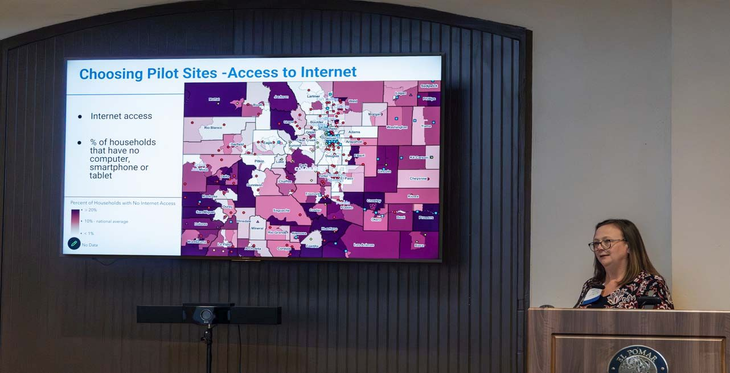
Tiah Frankish, Director of Library Development, Colorado State Library provided an overview of the "Connect to Health at Your Library" program, a partnership with OeHI and the Colorado State Library. This initiative funded 26 rural libraries to serve as "telehubs" for residents who lack high-speed internet or private space for medical appointments. Libraries offer private spaces with reliable broadband, medical tools, and telehealth kits that patients can check out for home use. These hubs allow community members to attend sensitive appointments, such as behavioral health therapy, with increased privacy and reduced social stigma.
Delivering Diabetes Prevention & Management Programming through Telehealth in Colorado was the focus of the presentation by Lisa Bentley, MS, RDN, CPH, Diabetes Management Coordinator and Monica Thompson, Diabetes Prevention Coordinator for the CO Department of Public Health & Environment. They summarized the National Diabetes Prevention Program Lifestyle Change Program and how it can reduce a person's risk of developing type 2 diabetes by 58%. And, for those over 60, it's, closer to, 70-71%. It is typically delivered in groups, through in-person meetings, online platforms, and distance learning, but often suffers from participants tapering off and not finishing. Their Diabetes Self-Management Education and Support program empowers people to better manage their diabetes using community care coordinators. They developed best practices for implementing telehealth strategies with the goal of decreasing incidents and increasing prevention and management of diabetes.
Finishing up the day was Rachel Dixon, Founder and CEO of New Frontiers Health providing a perspective on inclusive healthcare, technology, and social justice. She focuses on "fostering responsible innovation" by ensuring that health IT tools are developed with an ethical and inclusive framework, emphasizing that making patients and providers the "architects" of the tools they use, ensuring that technology serves the person rather than just the process. She advocates for ensuring that digital roads are open to every neighbor, particularly veterans in rural communities and seniors who may feel lost within the traditional healthcare system.
Actionable Lessons for Success
Speakers shared several "lessons learned" for organizations looking to implement similar technologies:
- Physician Champions: Success depends on having at least one provider who can speak to their peers about the value of telehealth from lived experience.
- Intentional Design: Virtual programs should not just be "virtual versions" of in-person care. They require shorter, more engaging sessions and proactive tech support to prevent attrition.
- Data from Day One: Organizations must build their data capture and outcome reporting strategies before launching to ensure long-term sustainability and funding.
The summit concluded with a clear call to action: advocate to support treatment in place and ensure telehealth remains a dependable, permanent option for every neighbor in Colorado.